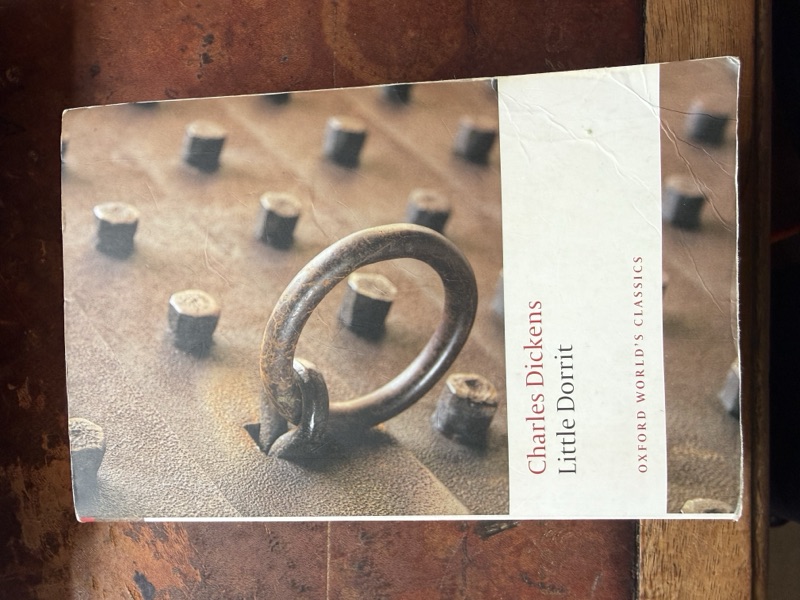
Little Dorrit appeared in monthly parts from December 1855 to June 1857. Charles Dickens was forty-three when he began it. His father had spent a year inside the Marshalsea debtors’ prison when Charles was twelve, briefly sending the boy into a blacking factory, and the novel is partly set inside that same Marshalsea, two decades after John Dickens’s release. It runs in two books, “Poverty” and “Riches”, with a long sustained satire on government inefficiency through the invented Circumlocution Office. Less acclaimed in its own time than Bleak House, the novel’s reputation has only grown.
Introduction by Robbie
Little Dorrit was the second Dickens I ever read. I was studying Our Mutual Friend at school, his last complete novel, and thought I should read another of the late great novels. The reading for Gilly was probably the fourth time I’d been through it with Amy Dorrit and Arthur Clennam.
The last lines (spoiler alert) are my favourite in all of Dickens:
“They went quietly down into the roaring streets, inseparable and blessed; and as they passed along in sunshine and in shade, the noisy and the eager, and the arrogant and the froward and the vain, fretted, and chafed, and made their usual uproar.”
That passage always makes me cry. Dickens sends two of his characters back out into the world, as if to say off you go now, and they are encompassed by the crowd. It reminds me of the shock of tenderness one feels for a loved one seen unexpectedly in a crowd, surrounded by indifferent strangers.
Listen to the complete Little Dorrit reading either directly here on the site or on your preferred platform